


Loss type: sump pump failure. Water category: Category 3, the contaminated classification. Rooms affected: four, including a finished basement living area and two bedrooms. Location: Louisville area, Kentucky.
We published a sump pump failure case study recently where the water was Category 1 and the job came in around eight thousand dollars. Same failure here. Different category. This one ran over thirteen thousand.
That gap is the whole lesson, so here is the job.
What Was Down There
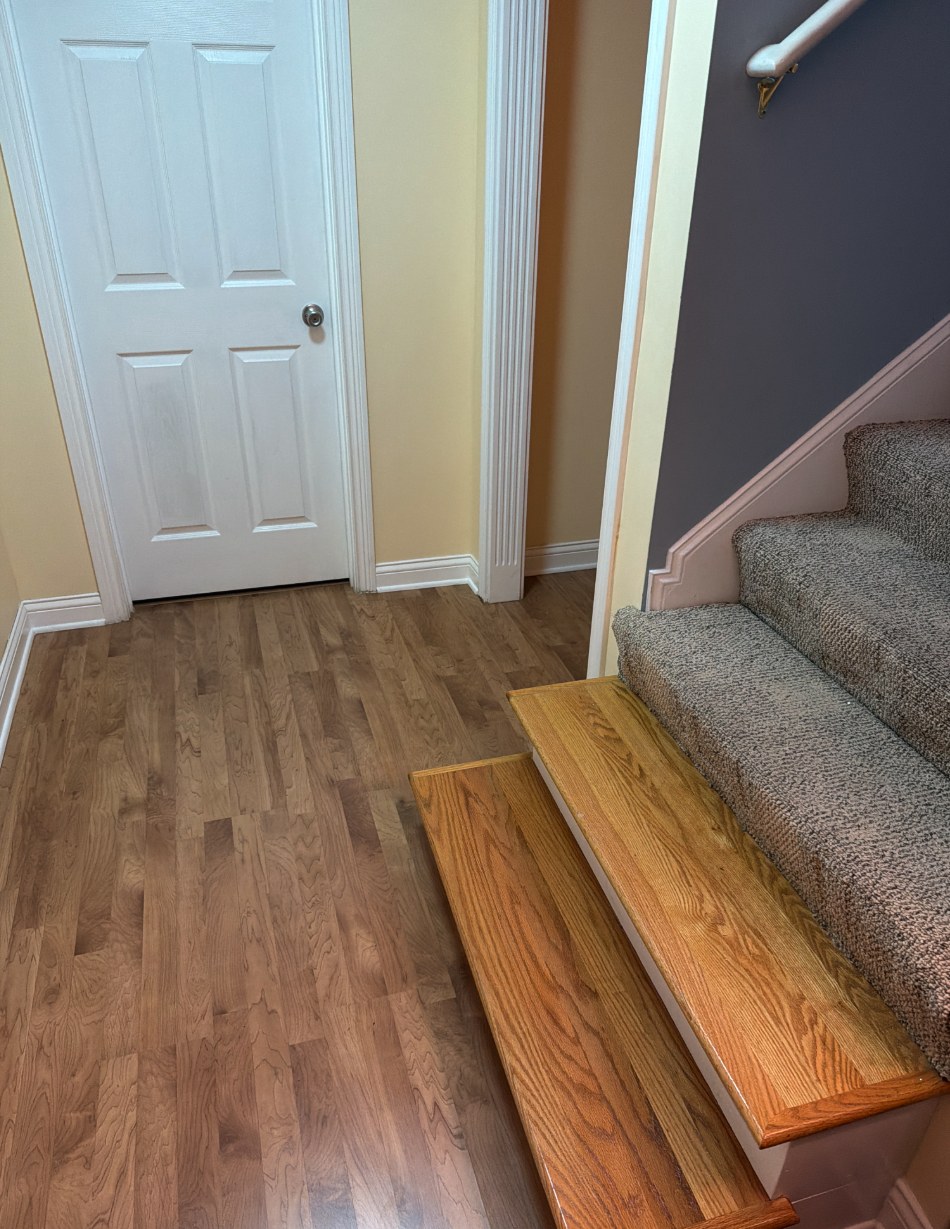
This was not an unfinished storage basement. Wood flooring, finished walls, carpeted stairs, two bedrooms and a bathroom on the lower level, and a family using all of it.
When a pit stops keeping up under a finished basement, the water does not announce itself with a flood. It wicks into the bottom of the walls, travels under the flooring, and sits in the pad and the slab while the room above still looks like a room.
Why This One Was Category 3
The IICRC sorts water into three categories. Clean is Category 1, grossly contaminated is Category 2, and Category 3 carries bacteria and real health risk. Groundwater that comes up through a failed pit is not clean supply line water. It has been in contact with soil and whatever the pit has been collecting, and it is classified accordingly. Our guide to the categories of water damage covers the distinctions.
The category is not a label on a form. It decides the entire scope. Category 3 means porous materials that got wet leave the house rather than getting dried in place, everyone works in protective equipment, the air gets filtered and controlled, and every piece of equipment is decontaminated before it goes back on the truck.
The Wall That Looked Fine
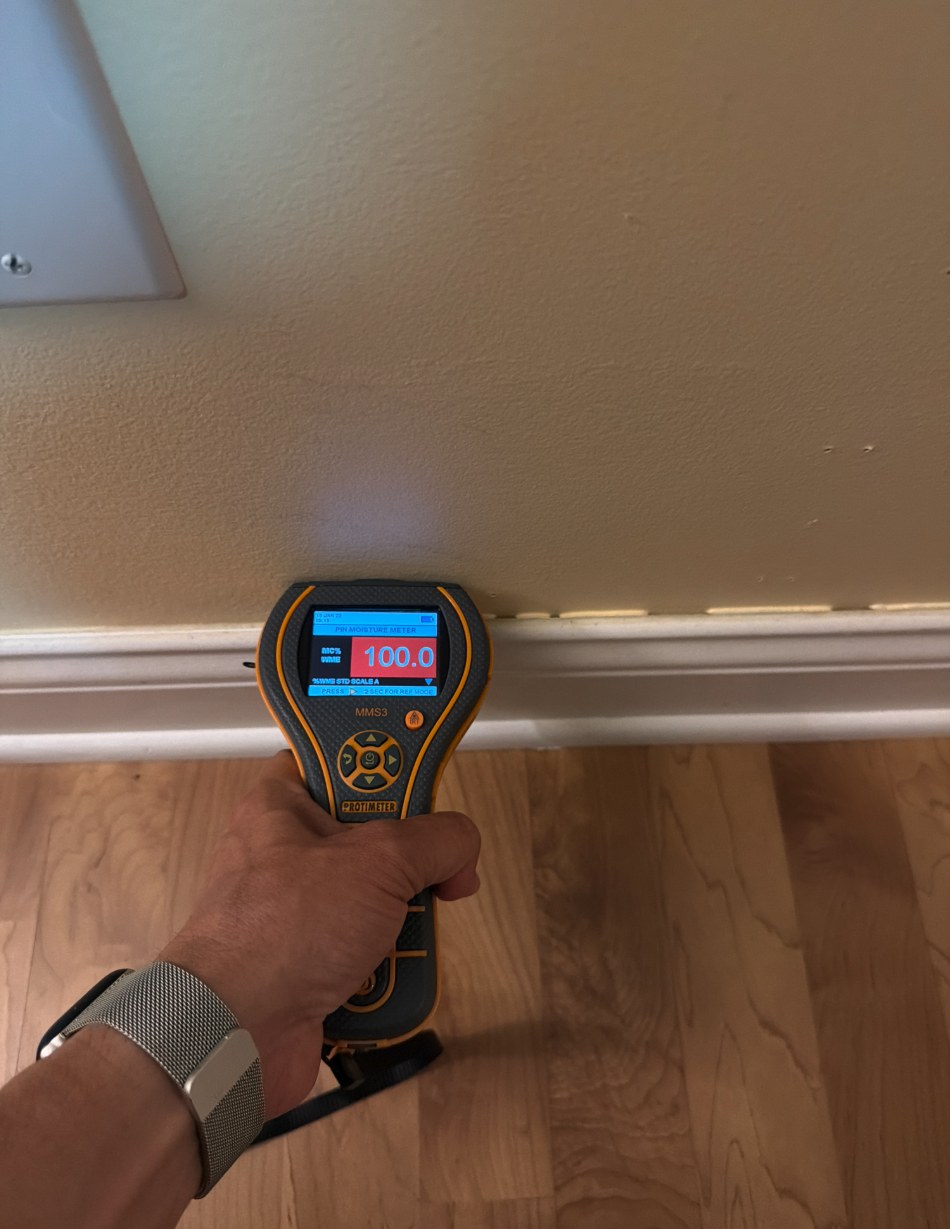
That is a pin meter reading 100 through drywall just above the baseboard, in a room that photographs as completely normal. No stain, no bubbling, no smell yet.
This is the single most common reason water damage jobs go wrong. The homeowner cleans up what they can see, the surface dries, and the wall cavity stays wet behind it. Six weeks later it is a mold call instead of a drying call. Meters, not eyes, decide what comes out.
Containment Came Before Cleanup
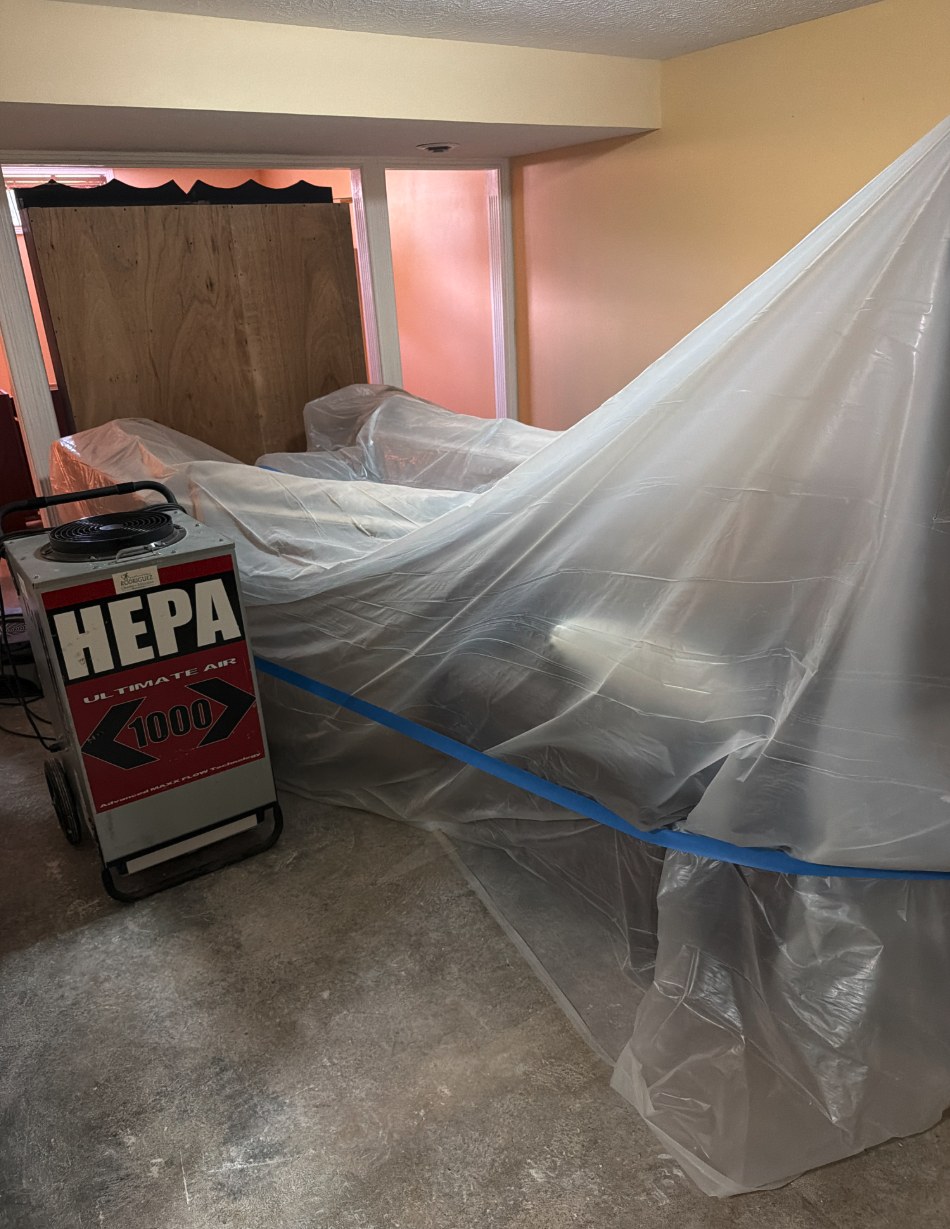
Before anything was torn out, the contents were sealed under sheeting and a HEPA air scrubber went on the space. On a contaminated loss, the first job is making sure the problem stays in the basement instead of traveling up the stairs into the rest of the house.
Full personal protective equipment went on at the same time. Heavy duty gloves, half face respirators with HEPA only cartridges, and the hazardous cleanup package. That is standard on Category 3 and it is not optional.
What Came Out
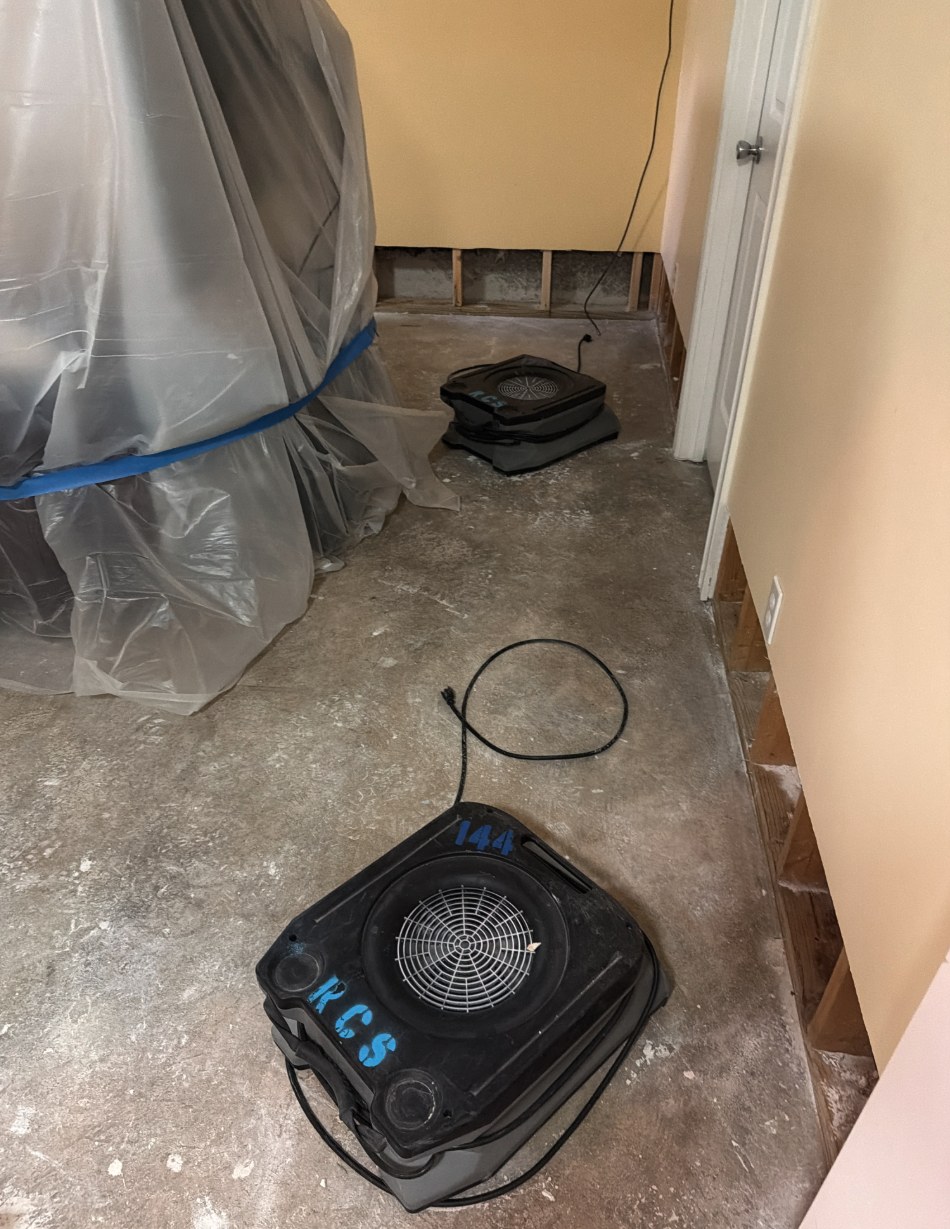
Flooring out. Baseboard off. Drywall flood cut above the water line so the framing and insulation behind it could be reached. A twelve yard dumpster of material, between one and three tons, left the property.
People push back on the demolition more than any other part of a restoration job, and it is understandable. Nobody wants their finished basement opened up. But porous material that absorbed Category 3 water cannot be cleaned back to safe, and drywall dried in place over wet insulation is a mold problem with a delay timer on it.
The Drying Bill Tells the Story
Two line items on this estimate are worth showing, because they explain why category matters so much to the final number.
- Air movers: $2,464.00
- Dehumidification, 110 to 159 pints per day: $1,045.44
- Equipment setup, take down and monitoring: $518.56
That is roughly four thousand dollars in drying alone, before a single piece of drywall gets replaced. Equipment ran across four rooms for over a week, from the first documentation to the final readings, because a finished basement with saturated walls and slab does not come back in three days.
Add the containment, the HEPA filtration, the PPE, the equipment decontamination and the debris haul, and you get the difference between a Category 1 sump pump job and a Category 3 one. Same pump. Same pit. Different water. Roughly five thousand dollars of difference.
The Part You Control
You cannot control what category the water is. That is decided by where it came from and how long it sat. You can control both of the things that push a job from the cheap version to the expensive one:
- Test the pump before the season you need it. Pour a bucket into the pit and confirm it kicks on and shuts off. Twice a year.
- Check the discharge line outside. A pump running into a blocked line has done nothing.
- Get a battery backup. The storm that fills the pit is the storm that takes the power out.
- Call the same day. Time is the variable that turns clean water into contaminated water.
- Ask your agent about water backup and sump overflow coverage. It is frequently a separate endorsement rather than something included by default.
Common Questions About Category 3 Basement Losses
Why is groundwater treated as contaminated?
Because of where it has been. Water that comes up through a sump pit has been in contact with soil and whatever has collected in the pit. It is not the same as a clean supply line that just burst, and it is not handled the same way.
Does all the drywall have to come out?
Not all of it. We flood cut above the water line, which usually means the bottom two feet, so the wet material is removed and the dry material above it stays. The height is set by the readings, not by habit.
Can I keep the furniture that was down there?
Hard, non porous items that can be cleaned and sanitized usually stay. Upholstered furniture, particle board and anything porous that sat in the water usually goes. We walk the contents with you rather than deciding behind your back.
How long does a basement like this take to dry?
Longer than people expect. Equipment on this job ran across four rooms for over a week. Drying finishes when the readings hit the dry standard, and a saturated slab with open wall cavities takes the time it takes.
Will insurance cover a sump pump failure?
It depends on your policy. Sump overflow and water backup are frequently written as a separate endorsement rather than included automatically, which is different from how a sudden pipe burst is usually handled. That is your carrier’s call. Our job is to document the loss thoroughly enough that the decision is made on facts, which is what our water damage insurance process page walks through.
Water Coming Up in Your Basement?
The category is set by how long it sits. That is the one part of this you still control, and it is worth thousands.
Call (502) 365-6779. Calls only, no texting. A live person answers 24 hours a day, seven days a week, and we are on site within one hour. Over 740 five star reviews from Louisville homeowners, IICRC certified, insurance billed directly, and we carry the job through the repairs.
Related: flooded basement cleanup, structural drying and dehumidification, and a Category 3 sewage backup in another Louisville basement.
