


Loss type: sump pump failure. Water category: Category 1, clean water. Rooms affected: four, across two levels. Location: Louisville, Kentucky.
A sump pump quit. That is the whole story of how this one started. No burst pipe, no storm damage, no dramatic moment. A pump that had been doing its job for years stopped doing it, the pit stopped keeping up, and water went where it always goes, which is everywhere lower than where it started.
Here is the full job, with the homeowner details left out.
The Call Came In After Hours
This one was billed as an after hours emergency service call, which matters more than it sounds. Sump pumps almost never fail at a convenient time. They fail during the storm, overnight, or on the weekend, which is exactly when the water gets its longest uninterrupted run before anybody notices.
A live person answers our phone 24 hours a day and transfers to an on call technician. That is not a slogan, it is the reason this job started the same night instead of the next morning.
What a Failed Sump Pump Actually Floods
Four separate areas came back wet:
- The play room, the largest affected space
- A bathroom, 5.9 by 4.6 feet, 27 square feet
- The TV room
- The upstairs hallway
People picture a sump pump failure as a puddle around the pit. It is not. Water tracks along the slab, under carpet and pad, through door thresholds, and into rooms that look completely dry from the doorway.
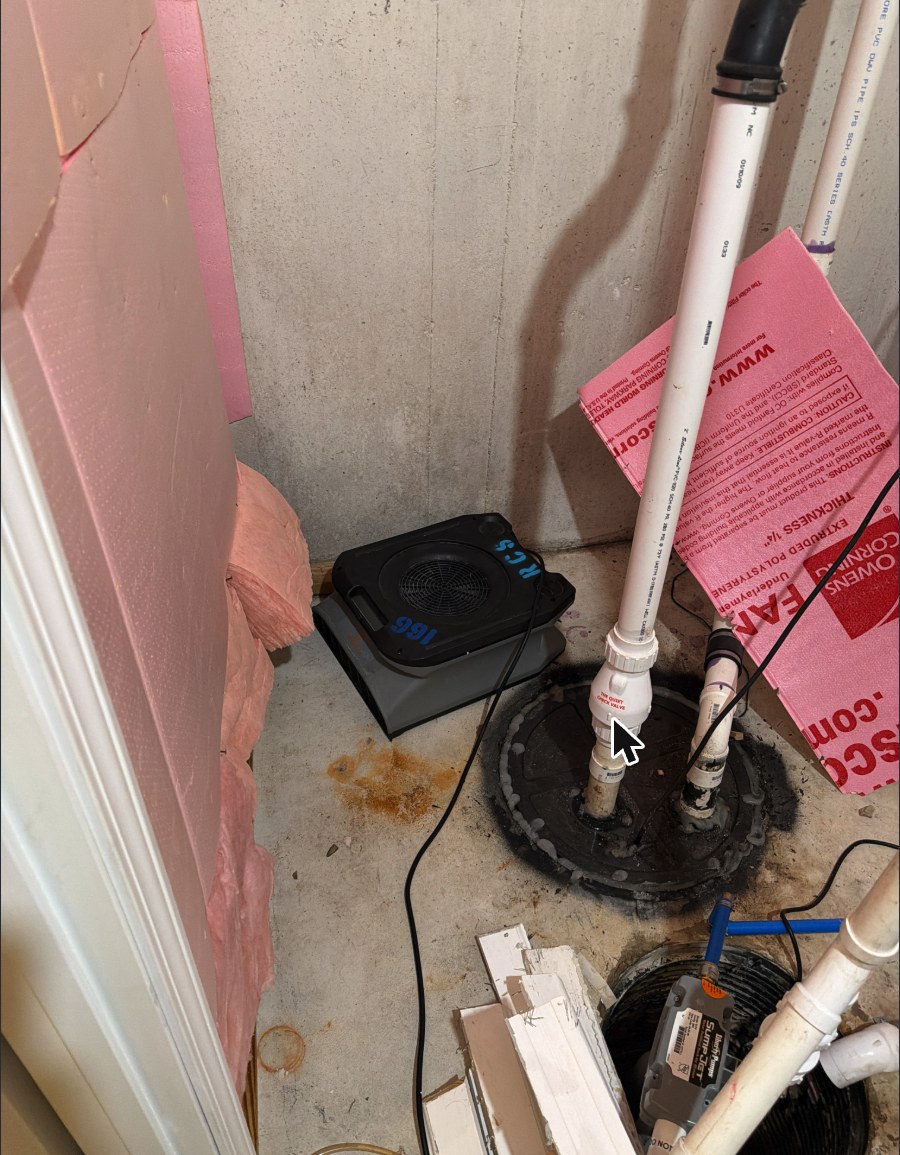
That is the pump, pulled out of the pit. Look at the rust staining on the slab around it. That is the record of how many times water reached that height before anyone caught it.
Category 1 Does Not Mean Harmless
The water here was Category 1, the clean water classification. Clean water is the best case, and it still soaked carpet, pad, drywall bottoms and flooring across four areas of the home.
The thing to understand about Category 1 is that it does not stay Category 1. Standing water degrades. Given warmth, time, and the organic material already sitting in carpet and pad, clean water becomes contaminated water within a couple of days. The only reason this stayed a clean water job is that it did not sit. More on how that works in our guide to the categories of water damage.
Finding the Water You Cannot See
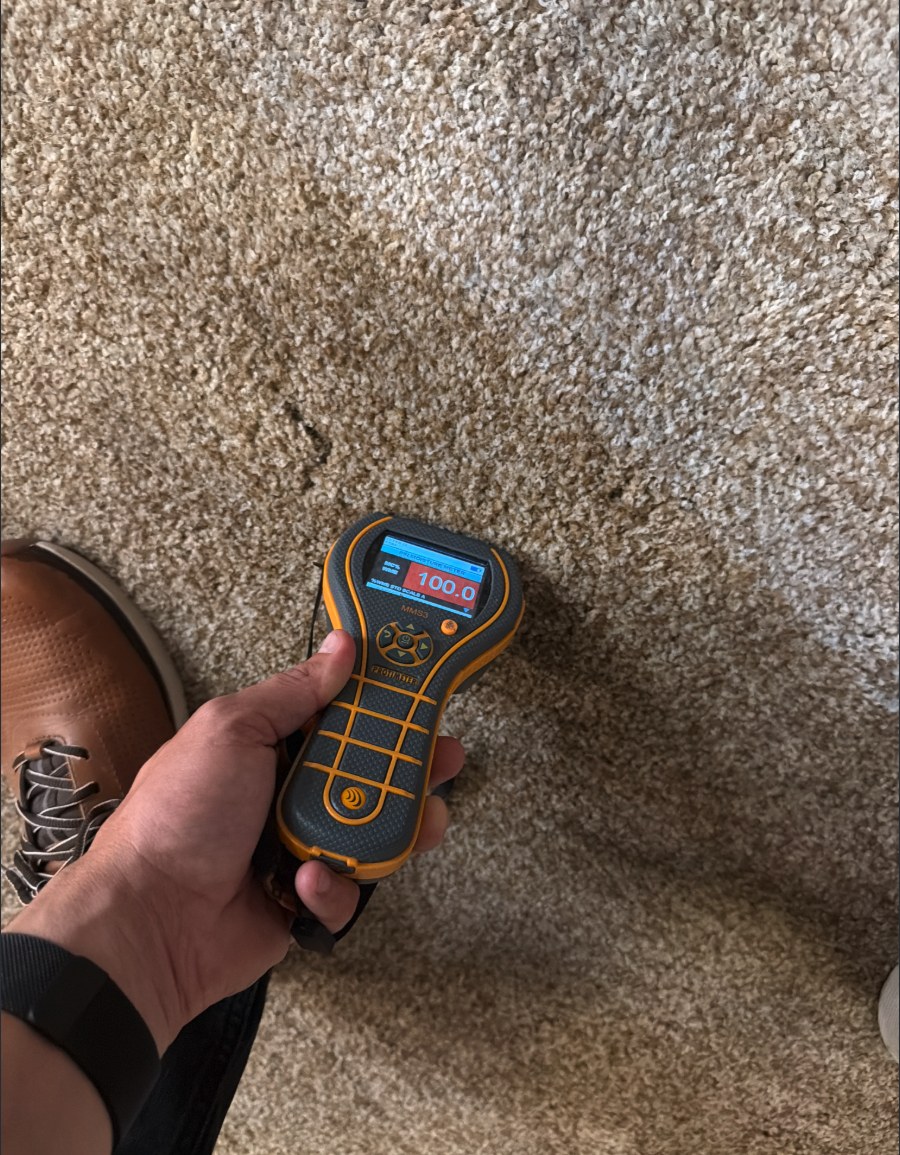
That meter reads 100 on carpet that looks close to dry in the photo. The eye is not a moisture detection tool. Neither is a hand on the floor.
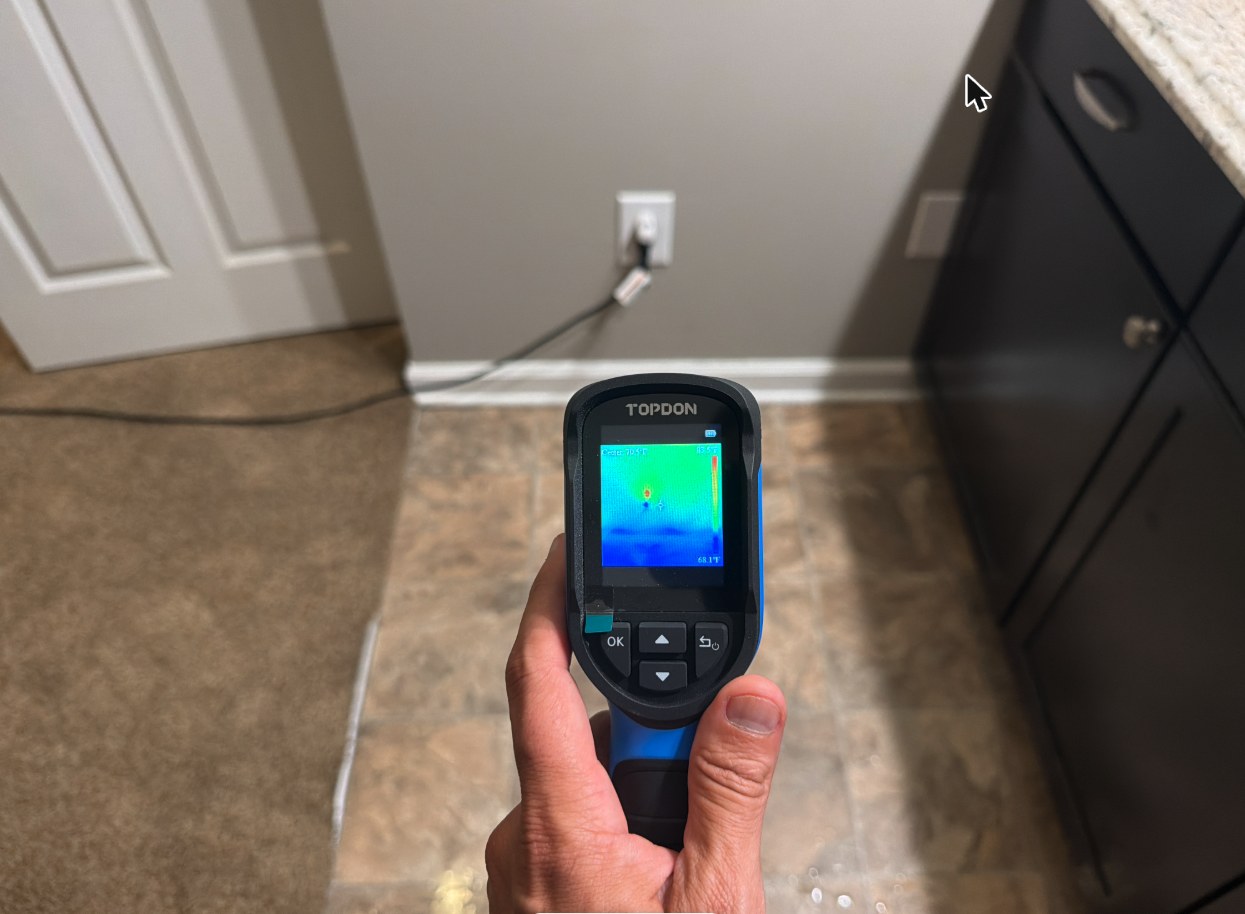
Thermal imaging goes a step further. Evaporating water pulls heat out of a surface, so wet drywall reads colder than dry drywall. That blue and green signature on the camera screen is water inside a wall cavity that nobody would find by looking at it.
This is the part of the job that decides everything after it. Miss a wet wall on day one and you get a mold call in six weeks. Every affected area here was mapped with readings and photographed before a single thing came out.
What We Removed
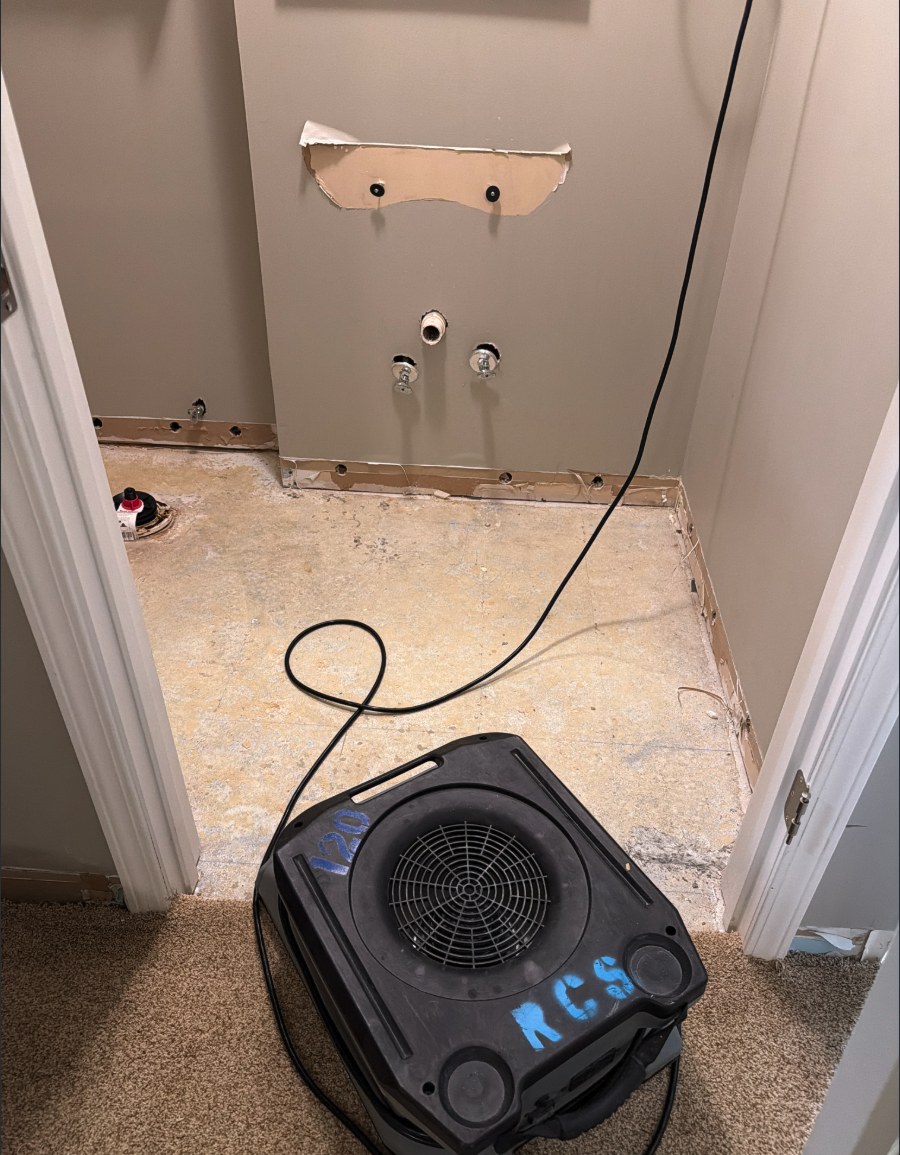
Wet flooring came out. Baseboard came off. Lower cabinets were detached so the wall and floor behind them could be reached and dried instead of sealed up wet. Inspection cuts were opened where the readings said water had gotten behind the surface.
The removed material, between one and three tons of it, went into a twelve yard dumpster and off the property. Saturated pad and swollen flooring do not come back. Trying to dry them in place is how a manageable job turns into a mold remediation job.
Drying the Structure
With the wet material out, air movers went in to move air across the exposed subfloor and into the open cavities, with dehumidification pulling that moisture back out of the air. Readings were taken and photographed as the work went, area by area.
The goal is never a schedule. It is a number. Equipment comes out when the structure reads dry, and the only way to know that is to measure it. The mechanics of that are on our structural drying and dehumidification page.
The Insurance Side
This loss went through the homeowner’s carrier, with the estimate written in Xactimate and the photos and readings sent with it. We bill carriers directly and we work with most of them, including State Farm, Travelers, Kentucky Farm Bureau and Liberty Mutual.
Sump pump failures deserve a specific note. Coverage for them is not automatic on every policy the way a sudden pipe burst often is, and many carriers treat water backup and sump overflow as a separate endorsement. That is your policy language and your carrier’s decision, not ours. What we control is documenting the loss well enough that the decision gets made on facts.
What This Job Should Tell You About Your Own Sump Pump
- Test it before you need it. Pour a bucket of water into the pit and confirm the pump kicks on and shuts off. Twice a year is enough.
- Check the discharge line outside. A pump running perfectly into a blocked or frozen line has accomplished nothing.
- Consider a battery backup. The storm that fills your pit is the same storm that takes your power out.
- Know how old it is. These are mechanical parts that run wet. They do not last forever and they rarely warn you.
- Ask your agent about water backup coverage before you find out the hard way.
Common Questions About Sump Pump Failures
How fast do I need to call?
Immediately, at whatever hour it happens. Clean water can degrade into contaminated water in roughly two days, and at that point material that could have been dried has to be removed instead. We are on site within one hour.
Can I just rent fans from the hardware store?
You can move air with them. You cannot pull moisture out of the air with them, and you cannot measure what is happening inside a wall with them. Without dehumidification you are circulating wet air around a closed basement, and without meters you are guessing about when to stop.
What does this kind of job cost in Louisville?
Our minimum for water damage, including drying equipment, is $1,500. A four area loss like this one runs well above that. The number depends on how much material is affected and how long equipment has to stay, and we put it in writing before the work starts.
Do you handle the repairs afterward?
Yes. We are a full water damage restoration company, from the first extraction through the rebuild. The same crew that dries the house puts it back.
Sump Pump Failed? Call Before It Sits
Every hour of delay moves this job from drying material to replacing material. If your pit is overflowing or your floor is wet right now, do not wait for morning.
Call (502) 365-6779. Calls only, no texting. A live person answers 24 hours a day, seven days a week, and we are on site within one hour. Over 740 five star reviews from Louisville homeowners, IICRC certified, insurance billed directly.
Related reading: flooded basement cleanup, and a burst pipe that ran three days and what that cost.
