Sewage Cleanup in Louisville, KY
A sewage backup exposes your property to bacteria, viruses, and Category 3 contamination that can spread through flooring, drywall, and belongings. Our certified Louisville team responds 24/7 to contain the affected area, extract the sewage, remove unsafe materials, and thoroughly clean and disinfect your home.
Sewer Backup Cleanup in Louisville, KY: Trusted Sewage Cleanup Company
A sewage backup is a Category 3 water loss, which means the affected area may contain bacteria, viruses, and other harmful contaminants. Carpet, padding, drywall, and insulation that absorb sewage often cannot be safely restored. Our Louisville sewage cleanup team uses protective equipment and containment to control the work area before removing wastewater and contaminated materials.
Because a sewage backup is a water-related loss, our water damage restoration in Louisville service is often part of the recovery.
After removal, every salvageable surface must be cleaned, treated, and dried in the correct sequence. Our certified cleanup crew uses professional antimicrobial products, HEPA air filtration, and moisture monitoring to address both sanitation and hidden dampness. This gives your family a safer path back into the space and helps prevent persistent odor, contamination, and mold.
Direct Insurance Billing
Category 3 Safety Protocols
Cleaning and Decontamination
Filing a Water Damage Insurance Claim? We Bill Your Insurance Company Directly So You Don’t Have To!
Sewage cleanup requires records of the affected materials, removal, cleaning, and drying. We complete mitigation before preparing its final Xactimate estimate, then meet your adjuster for the repair walkthrough. We offer direct insurance billing, but your insurer determines coverage and payment. Read our sewage mitigation and repair insurance process for the full sequence.


Testimonials
Sewer Backup Cleanup Reviews from Louisville Homes

Nobody plans for the day sewage backs up into their home. When it happens, Louisville homeowners call Rodriguez Cleaning and Restoration because we show up fast, treat a contaminated home with respect, and make it safe and livable again. See what they have to say below.
What To Do the Moment You Find a Sewage Backup
A sewage backup needs professional contaminated-water cleanup. Keep people out of the affected area and avoid contact with wastewater or soaked belongings. The EPA recommends experienced professional help for sewage-related water damage. Call us 24/7 to discuss the cleanup.
Service illustration (not a job photo).
-
1. Keep the affected area off limits. Keep children, pets, and other occupants away from sewage water and soaked items. Do not walk through the backup to retrieve belongings.
-
2. Have the backup source addressed. Contact the appropriate plumbing or sewer professional about the continuing backup. Tell our cleanup team whether wastewater is still entering the home.
-
3. Avoid wet electrical equipment. Stay away from wet outlets and appliances. Do not enter wastewater to reach a breaker; electrical hazards require qualified help.
-
4. Document without handling contamination. Take photographs only from a safe, unaffected location. Notify your insurer and ask what records it needs before damaged items are removed.
-
5. Arrange professional cleanup. Call Rodriguez at (502) 365-6779. Describe the affected rooms so we can plan wastewater removal, material cleanup, and subsequent drying.
We are Ready for You? Call Us for Top-Notch Sewage Cleanup Service!
Our Process
Rodriguez Restoration 8 Steps for Sewage Cleanup in Louisville, KY
Sewage cleanup is a contamination-removal project followed by drying. We assess the work area, remove wastewater and affected materials, clean remaining surfaces, and verify drying before moving to repairs.
Our role is restoring the affected property. A qualified plumbing or sewer professional should address the backup source so wastewater does not continue entering.
Call our 24/7 team and tell us where wastewater appeared, which rooms it reached, and whether the backup is continuing. Keep people away from the affected area. A plumbing or sewer professional may be needed to address the source while we plan the property cleanup.
We identify the affected surfaces and materials and plan access, protective equipment, and containment for the cleanup. This is a contaminated-water assessment, not simply a plan to dry a wet floor. We explain the proposed mitigation work and authorization before starting.
Our crew extracts sewage water and removes debris from the affected area using professional equipment. We work to limit movement of contamination into unaffected rooms. Removing the visible wastewater is the beginning of cleanup, not its completion.
We assess sewage-affected carpet, padding, drywall, insulation, and other porous materials for necessary removal. We explain and document the removal scope. Contaminated materials should not be treated as reusable just because they can be dried.
After wastewater and unsalvageable materials are removed, we clean accessible remaining surfaces and apply appropriate professional treatment. Cleanup addresses the affected materials, not just the odor. The work plan accounts for where wastewater traveled in the room.
Once the necessary cleanup is complete, we use drying equipment and moisture readings to address dampness in remaining structural materials. Our structural drying service follows the cleanup stage rather than replacing it.
After mitigation is finished, we prepare the final mitigation estimate with photos and moisture records. A rough initial estimate is not the final bill or the later repair estimate. We use Xactimate and offer direct insurance billing; your insurer determines coverage and payment.
We return for the repair walkthrough with your adjuster after mitigation. With your authorization, we review and negotiate the restoration scope and price. Repairs begin once the work and price are agreed and you authorize them. Our insurance process guide explains this sequence.
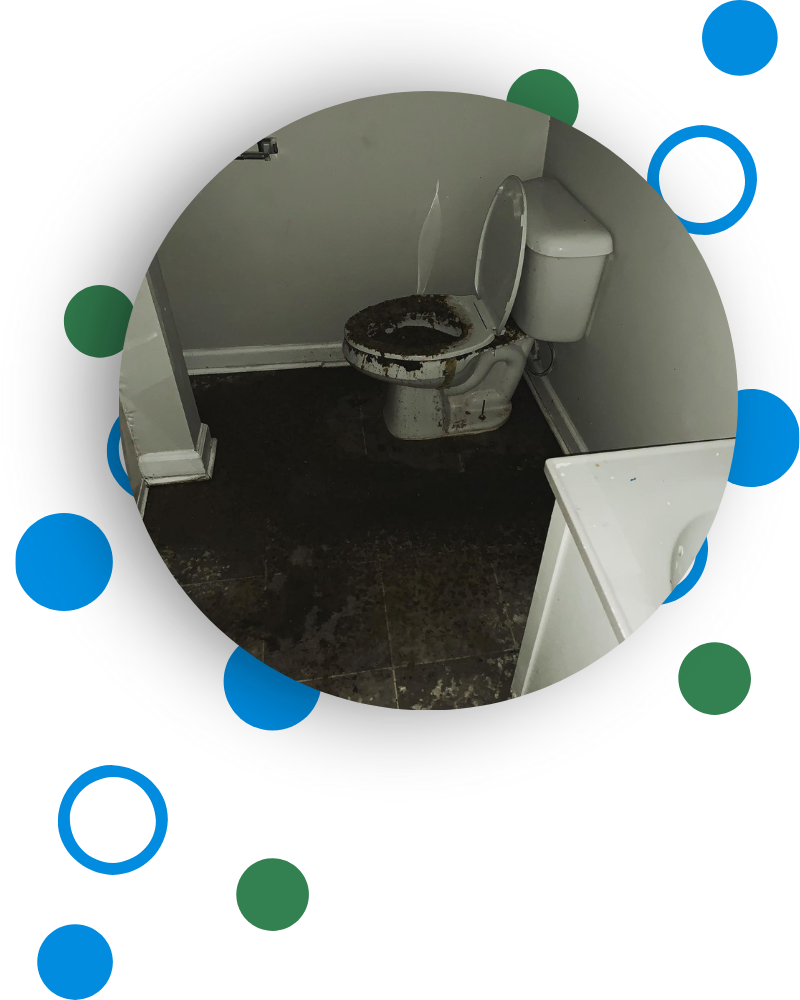
Service illustration (not a job photo).
Gallery
Our Sewage Cleanup Results in Louisville, KY
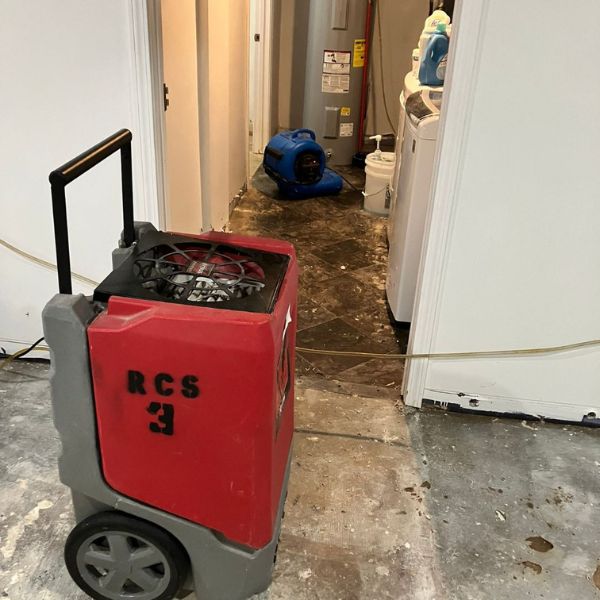
These photos are from sewage cleanup in a Louisville home: a bathroom where contaminated flooring was removed, the subfloor was cleaned and treated, and the room was dried with air movers. For a start-to-finish basement example, with homeowner details left out, see our sewage backup case study.
Common Sewage Backup Situations We Clean Up in Louisville, KY
The source of a backup and the materials it reaches shape the cleanup plan. Tell us where wastewater appeared and whether the source is still active. Our role is restoring the affected property; plumbing and sewer repairs require the appropriate professional.
Sewer line backups. Wastewater entering through low drains can affect flooring, walls, and stored belongings. We assess the work area, remove wastewater, and explain necessary material cleanup.
Toilet overflows involving waste. We assess contamination beyond the visible mess, including affected flooring and nearby materials. Tell us what overflowed rather than assuming that every toilet-related leak has the same source.
Basements with sewage. Our flooded basement cleanup includes assessment of affected lower-level materials. When sewage is present, removal and cleaning come before drying the remaining structure.
Water after a sump pump failure. A sump failure is not automatically a sewage backup. We assess the source and condition of the water, then explain the appropriate extraction, cleaning, and drying scope.
Septic backups into the home. Have the septic-system problem addressed by the appropriate specialist. Our crew assesses and restores the affected interior areas using a contamination-focused cleanup plan.
Drain and floor-drain backups. Tell us whether wastewater came from a drain, fixture, or another source. We assess where it traveled before deciding the removal and cleaning scope.
Porous materials affected by sewage. Carpet, padding, drywall, and insulation that absorb wastewater may need removal. We explain material decisions and document the work; drying alone does not resolve contamination.
Odor after a backup. We address wastewater, affected materials, cleaning, and remaining moisture rather than covering the smell. Tell us about persistent odor so it can be assessed. Odor improvement alone is not proof that cleanup is complete.
Sewer Backup Cleanup in Louisville: Why Basements Back Up
Many older Louisville neighborhoods were built with combined sewers, where rainwater and household wastewater share the same pipes. Louisville MSD notes that when those combined sewers were overloaded with stormwater, the polluted water often backed up into basements. Today a heavy storm, a clogged lateral line, or tree roots in an older clay pipe can still push sewage up through a floor drain, shower, or toilet on the lowest level of a home.
If sewage has backed up into your basement, keep children and pets out, stop running water and flushing, and call us. Our crew extracts the sewage, removes materials that cannot be saved, cleans and disinfects every affected surface, and dries the structure so odor and mold do not follow.
After the cleanup, ask Louisville MSD about its Plumbing Modification Program, which can install a backflow prevention device for homes that have had rain related basement backups.
Ready For a Fresh Start? Call Us for Top-Notch Cleaning and Restoration!
About Us
What Sewer Backup Cleaning Services in Louisville Include
When a sewer backup reaches a Louisville home, the work you need is more than pumping out water. Sewer backup cleaning services include containing the contaminated area, removing wastewater, taking out materials that cannot be saved, cleaning and treating what remains, and drying the structure with moisture readings. A plumber or sewer contractor handles the line itself so the backup does not keep coming in.
If you are filing a claim, the same visit should produce the photos and moisture records your adjuster will ask for. The insurance section above explains how we document the loss and bill the carrier. Your insurer still decides coverage.
Rodriguez is a locally owned Louisville company, and the sewage crew is available at (502) 365-6779 any time of day. If wastewater is in the house now, tell us which rooms it reached and whether it is still coming in.
Service illustration (not a job photo).
FAQs
Our Sewage Cleanup FAQs
A certified crew is on the way in 60 minutes or less, 24/7. With a biohazard like sewage, response time directly affects how much of your home stays safe and how large your insurance claim becomes. The faster we contain and extract it, the less contamination spreads into flooring, walls, and air.
Extraction and decontamination often happen the first day. Structural drying then runs about 3 to 5 days depending on how far the contamination spread and how much material had to be removed. We monitor with daily moisture readings and do not close out until your home reaches a documented dry standard.
Your insurer determines whether the cause of the backup is covered under your policy. We document sewage mitigation and offer direct insurance billing, but cannot guarantee claim approval or payment. Our insurance process guide explains the completed mitigation estimate, later repair walkthrough, and billing steps.
Yes. We are a locally owned Louisville company and we are fully insured. When you call us for a sewage backup, you are dealing with trained technicians who handle contaminated water, not a general handyman. We can provide proof of insurance on request before any work begins.
Our water damage service has a $2,500 minimum including drying equipment, not a flat price for every sewage loss. The affected area, contaminated-material removal, cleaning, and drying requirements determine the mitigation scope. We can provide a rough estimate initially and prepare the final mitigation estimate after completion. Repairs are estimated separately. For a fuller breakdown of what affects the price, see sewage cleanup cost in Louisville.
Sewage-contaminated water requires appropriate precautions and experienced cleanup help. Avoid contact with the wastewater and keep others out of the affected area. Do not treat the backup as a routine spill or enter it to handle electrical equipment. Call us to discuss professional removal, cleanup, and drying.
Not every item is assessed the same way. Porous materials that absorbed sewage may require removal, while suitable remaining surfaces may be cleaned and treated. We explain the proposed scope and document affected materials; drying alone does not make contaminated materials reusable.
We address the wastewater and affected materials, then clean and treat remaining accessible surfaces and dry the structure. Covering an odor does not resolve the source. Tell us if an odor remains so we can assess it; smell alone is not a clearance test for the room.
Sewage is Category 3 contaminated water, so it requires containment, protective equipment, biocide treatment, and disposal of porous materials, on top of the extraction and drying that a clean-water loss needs. In short, it is a biohazard job, not just a water job. That is why sewage cleanup has to be handled by trained technicians using Category 3 safety procedures, not treated like an ordinary spill.
Yes. Rodriguez Cleaning & Restoration is a locally owned Louisville company and is open 24 hours. If you are searching for sewage cleanup near me, call (502) 365-6779 any time of day.
A backup usually starts with a blockage or a line that cannot carry what is in it. In this area that often means tree roots in an older clay service line, a clog or collapse in the lateral that runs from the house to the main, or a hard rain that fills the municipal pipes until wastewater comes back up through a basement drain, shower, or toilet. Newer subdivisions can have backups too, especially if a private line is blocked. Tell us where the water appeared; a plumber or sewer contractor should find and fix the source while we clean the rooms it reached.
Some steps are in your house, and some involve the line outside it. Inside, avoid putting grease, wipes, or paper towels down drains or toilets, and keep the clean-out accessible so a plumber can reach the line. A backwater valve, sometimes called a backflow prevention device, is a fitting on the sewer line that closes if wastewater tries to flow back into the house. If a rain-related backup has already come up through a basement fixture, Louisville MSD runs a Plumbing Modification Program that may help eligible homes add that kind of device after the cleanup. MSD, not our company, sets the program rules and does the approval. Our work is the contaminated-water cleanup; a licensed plumber installs the valve.
Wastewater coming up from a floor drain, toilet, or shower is the clearest sign, especially on the lowest level of the house. Other signs include a sewage odor that does not clear, slow drains in several fixtures at once, or standing dark water you did not spill. Do not judge safety by color or smell alone, and do not walk through the water to investigate. Keep people and pets out and call (502) 365-6779 so we can assess the rooms involved.
Leave the affected rooms, keep children and pets out, and stay away from wet outlets or appliances. If you can take photographs from a dry doorway without stepping in the water, do that for your insurer, then call us at (502) 365-6779. Tell us which rooms are involved and whether water is still coming in. Do not scoop, mop, or pull up carpet yourself, and do not turn on fans that could spread contaminated air. Our crew will contain the area, remove the wastewater, and explain the next steps.
If you have another question about a sewer backup in your Louisville home, call (502) 365-6779 and we will talk it through with you.
Services
After Sewer Backup Cleaning: Drying and Repairs in Louisville
Sewage cleanup addresses contamination as well as water damage. After necessary removal and cleaning, the remaining structure may need drying and repairs through our water damage restoration service. Explore other cleaning and restoration services below.
Service illustration (not a job photo).

Restoration Services
-
Sewage Cleanup
Service Area
Sewer Backup Cleanup Near You in Louisville
Rodriguez Cleaning and Restoration serves Louisville and nearby Kentucky communities, including Jeffersontown, St. Matthews, Prospect, Middletown, Anchorage, and the Highlands. Call (502) 365-6779 with your property location and the water damage situation so our team can confirm service availability and the next steps.
Sewage cleanup near you: